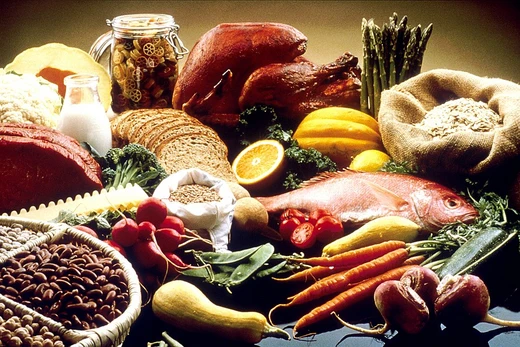
Vegetable
Edible plant parts, cultivated since early agriculture.

Vegetables are edible parts of plants consumed by humans or other animals as food. They include flowers, fruits, stems, leaves, roots, and seeds, and are defined somewhat arbitrarily by culinary and cultural tradition, often excluding fruits, nuts, and cereal grains.
- first recorded in English
- early 15th century
- largest producer
- China
- recommended daily intake
- five or more portions
- botanical definition
- matter of plant origin
- culinary definition
- plant part consumed for food that is not a fruit or seed, but including mature fruits eaten as part of a main meal
Lore & Background
At first, locally growing plants were cultivated, but trade later brought common and exotic crops from elsewhere. Nowadays, most vegetables are grown globally as climate permits, with crops sometimes cultivated in protected environments in less suitable locations. The scale of production ranges from subsistence farmers to agribusinesses with vast acreages of single-product crops. The word 'vegetable' was first recorded in English in the early 15th century, from Old French, originally applied to all plants. The exact definition varies: botanically, a vegetable is any plant matter, while culinary definitions often exclude fruits and seeds, though savoury fruits like tomatoes and squash are included. The U.S. Vegetables play an important role in human nutrition, being low in fat and carbohydrates but high in vitamins, minerals, and dietary fiber. Many nutritionists recommend five or more portions a day. Research has shown that eating more than five servings daily is associated with a twenty percent lower risk of coronary heart disease or stroke. However, vegetables also contain natural toxins and antinutrients that interfere with nutrient absorption.
Reader's Guide
Vegetables are significant as a fundamental component of human diet and nutrition, providing essential vitamins, minerals, and dietary fiber while being low in fat and calories. The term itself evolved from a general reference to all plants to a specific food category by the 18th century. Supreme Court case Nix v. Hedden, which classified the tomato as a vegetable for taxation despite its botanical status as a fruit. Vegetables are now produced globally, with China as the largest producer, and their consumption is linked to reduced risks of chronic diseases such as cancer, stroke, and cardiovascular disease. However, they also contain natural toxins and antinutrients, reflecting their role as plant defenses. The legacy of vegetables includes their central place in subsistence agriculture and global trade, as well as their ongoing importance in public health recommendations.
Did You Know?
- The word 'vegetable' was first recorded in English in the early 15th century, from Old French.
- China is the largest producer of vegetables worldwide.
- Eating more than five servings of fruits and vegetables daily is associated with a twenty percent lower risk of coronary heart disease or stroke.
The Elusive Definition of a Vegetable
The concept of what qualifies as a vegetable resists a single, clean answer. At its broadest, the term can simply mean anything of plant origin, a usage that persists in scientific and technical language where phrases like "vegetable matter" or "vegetable kingdom" refer to all plant life, edible or otherwise. A tighter everyday definition narrows the scope to any part of a plant that humans eat, whether that part is a root, stem, leaf, flower, fruit, or seed. An even more precise formulation excludes true fruits and seeds while still admitting mature fruits that are served as part of a main meal, a category that pulls tomatoes, squash, and broccoli into the vegetable camp. Adding to the confusion, edible mushrooms and seaweed—neither of which is technically a plant—are routinely grouped with vegetables in kitchens and markets worldwide. The result is a term whose boundaries shift depending on whether a botanist, a chef, or a shopper is doing the defining.
From Wild Foraging to Global Supply Chains
Long before the first plow cut a field, humans gathered edible plant parts—fruits, nuts, stems, leaves, corms, and tubers—directly from the wild. Selective breeding for traits like larger fruit and sturdier growth followed naturally. Over centuries, trade networks carried both common and exotic crops into new regions, enriching local diets beyond what a single climate could produce. Today, vegetables are cultivated wherever climate allows, and in less suitable areas they are grown in protected environments. China stands as the world's largest vegetable producer, and international trade means a shopper in one country can buy produce grown on another continent. Production scales range enormously, from small subsistence farmers feeding their own families to massive agribusiness operations tending vast single-crop fields. After harvest, crops move through grading, storage, processing, and marketing before reaching the table.
The Tomato Verdict and the Fruit-Vegetable Divide
In everyday speech, fruit and vegetable are treated as opposites, yet the line between them is far less clear than it appears. Botanically, a fruit is the structure that develops from the ovary of a flowering plant. By that strict standard, tomatoes, eggplants, and bell peppers are all fruits, even though most people reach for them in the produce aisle and call them vegetables. The distinction, as it is commonly drawn, is shaped more by culinary and cultural habit than by any biological rule. Hedden. In a unanimous decision, the justices ruled that for the purposes of that tariff, a tomato is correctly identified as a vegetable. Crucially, however, the court acknowledged that botanically the tomato is a fruit. The ruling thus drew a pragmatic, trade-oriented boundary that has endured in common usage ever since, even as the biological reality remained unchanged.
Nutritional Role and the Evolution of the Word
Vegetables occupy a central place in human nutrition. They are generally low in fat and carbohydrates while being rich sources of vitamins, minerals, and dietary fiber, and they can be enjoyed raw or cooked. Many nutrition professionals advise people to eat five or more portions of fruit and vegetables daily, underscoring how integral these plant foods are to a balanced diet. The word itself has a long journey. First recorded in English in the early 15th century, "vegetable" came from Old French and was originally applied to all plants, a broad sense still visible in biological writing. Meanwhile, in scientific and technical contexts, the adjective retains its much wider original sense, covering all things "related to plants" regardless of edibility.
Frequently Asked Questions
What actually counts as a vegetable?
A vegetable is any edible part of a plant—leaf, stem, root, flower, or seed—that people cook or eat as food. The line is drawn by culinary and cultural habit rather than strict botany, which is why items like tomatoes or cucumbers get lumped in even though they are technically fruits.
What's the botanical vs. culinary difference between a vegetable and a fruit?
Botanically, a vegetable is just any matter of plant origin, an extremely broad category. In everyday cooking, though, a vegetable is a plant part eaten as part of a main meal that isn't a fruit or a seed, even if it grew from a flowering plant.
Which country produces the most vegetables?
China sits at the top of global vegetable output by a wide margin. Vegetables are grown on every continent wherever the climate permits, but no other nation matches China's scale of production.
How many servings of vegetables should I eat each day?
Most dietary guidelines recommend at least five portions of vegetables daily. The English word itself dates back to the early 15th century, so the idea of eating them as a staple has a very long history.
Elsewhere in the Food universe
Spotted an error? Know more?
This is a living reference — every entry is fact-audited, and reader corrections feed straight into our audit queue. Suggest an edit · See this site's audit record